Morally Grey Characters: What It Means, Why Readers Love Them, and the Best Reads
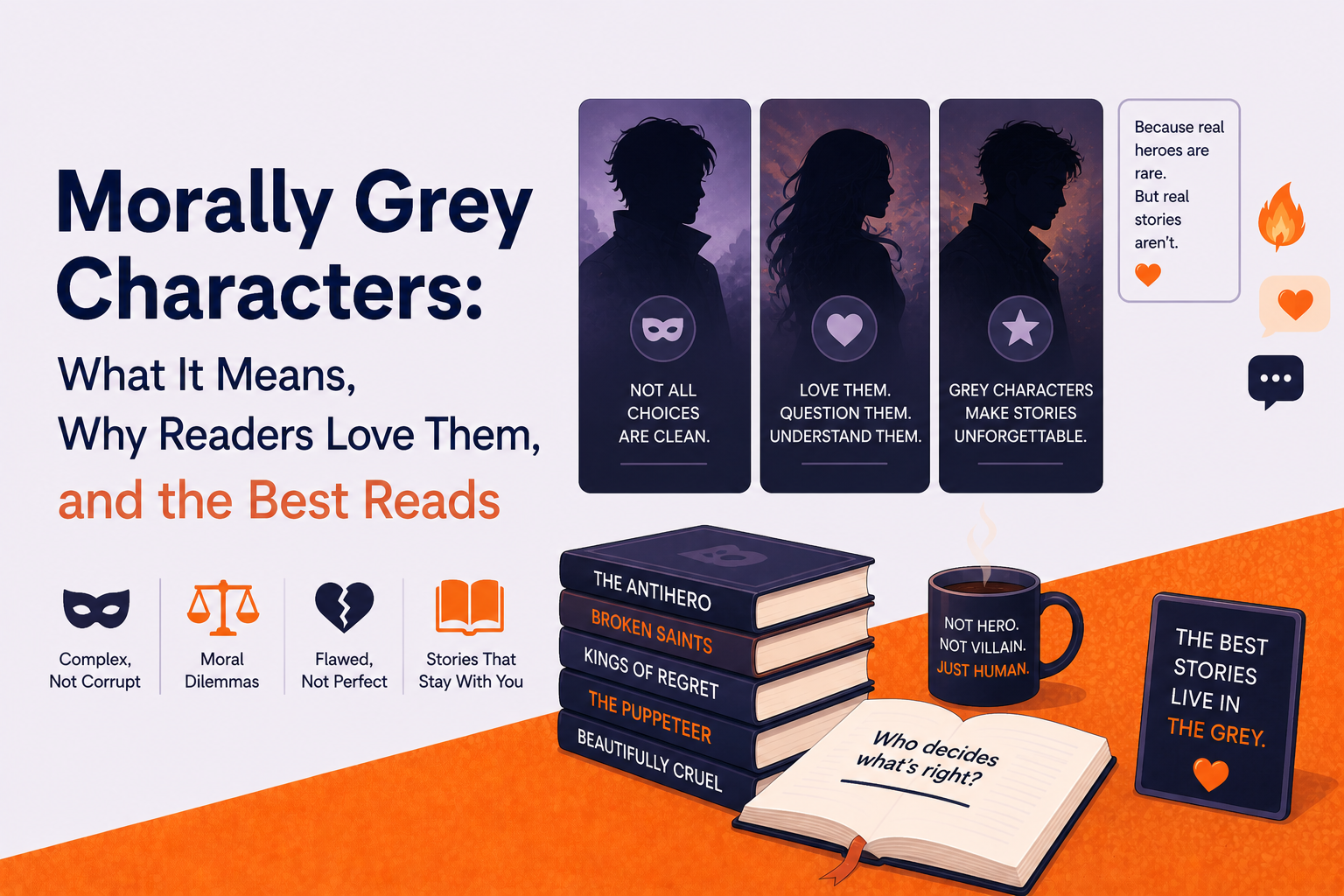
If you have ever rooted for the villain, defended a morally grey love interest to your book club, or highlighted passages from a character who probably belongs behind bars, you already understand the pull of this trope. The term morally grey has exploded across BookTok, romance Twitter, and Goodreads reviews, and for good reason.
These characters sit in the uncomfortable space between hero and villain, and that tension is exactly why readers cannot put their books down, cannot stop talking about them, and cannot stop searching for the next one that hits just as hard.
This guide breaks down what morally grey actually means, why these characters wreck readers in ways the traditional hero never could, how to spot a real morally grey book from a watered down imitation, the legendary characters who defined the trope, and how to craft one of your own. Whether you are a reader chasing your next obsession or a writer trying to build a dangerous love interest readers will remember for years, this is your full breakdown.
Quick Take: A morally grey character is one whose actions cannot be cleanly sorted into good or evil. They feel real because most of us live in that same space. The best ones stay with you long after the final page.
What Does Morally Grey Mean?
So what does morally grey mean in the simplest terms? A morally grey character is someone whose choices and motivations refuse to fit into clean boxes of good or evil. They do bad things for reasons that feel understandable. They do good things for reasons that feel selfish. They live in the same ambiguous space most real people occupy, which is why they feel so alive on the page and so uncomfortable in the best possible way.
The morally grey meaning goes deeper than just "flawed hero." A character with a bad temper or a tragic backstory is not automatically morally grey. The defining trait is genuine moral ambiguity. You are never fully sure whether to cheer for them, fear them, or both at once.
They might kill, lie, manipulate, or destroy, but they also protect, love fiercely, and show unexpected tenderness in moments that rewrite everything you thought about them. The reader is forced to sit with the discomfort of liking someone who has done terrible things, and that discomfort is the whole product.
In short, morally grey characters refuse easy judgment. And that refusal is the entire point of the trope. Any book that softens a morally grey character into someone obviously good by the halfway mark has abandoned the trope, even if the marketing says otherwise.
Morally Grey vs Antihero vs Villain
People throw these three terms around like they mean the same thing. They do not, and the distinctions matter if you want to find books that actually scratch the itch.
A traditional hero operates on a clear moral code and uses their power for good. Think Superman or Aragorn. Their struggles are external. You never doubt their goodness.
A villain is the antagonist. Their goals are harmful and usually selfish, and the story frames them as the obstacle to defeat. A villain love interest is a separate category, where the story is built around the tension of loving someone the narrative treats as dangerous.
An antihero is the protagonist who lacks typical heroic qualities. They might be cynical, reluctant, or morally compromised, but they usually land on the side of good by the final act. Think of characters who grumble through the whole adventure but still save the day.
A morally grey character is different because they never fully commit to either side. They can be the protagonist, the love interest, or even the antagonist. Their moral compass spins. You can read an entire series and still argue with your friends about whether they are redeemable. The ending might give them a partial answer, but the essential ambiguity stays with them.
This overlap is why antihero and morally ambiguous characters often get used as alternative terms, but a true morally grey character goes further than an antihero. An antihero typically has a reluctant heart of gold buried somewhere inside. A morally grey character might not. That uncertainty is the entire draw.
The Types of Morally Grey Characters
Not all morally grey characters wear the same shade. Understanding the subtypes helps you pick books you will actually love and helps writers design characters with intention.
The Righteous Criminal. They break the law constantly but live by a fierce personal code. Think Kaz Brekker or Robin Hood archetypes. The world calls them criminals. They call themselves something else.
The Reformed Monster. They have done horrific things in their past and cannot fully outrun them. The story is built on whether they can ever become someone new, or whether the old version still lives inside them. These characters work especially well in romance because the heroine becomes the witness to their becoming.
The Manipulator With a Heart. Cold, calculating, and willing to use anyone. Except the one person they will not use. These characters often drive the spiciest enemies to lovers arcs because the power dynamic is built into their personality.
The Morally Superior Killer. They take lives, but only lives they believe the world is better without. This subtype sits in the most uncomfortable territory because the reader is asked to agree with a character who has appointed themselves judge and executioner.
The Chaos Agent. They do not operate on logic or morality. They operate on their own rules, which shift based on what they want. These are the hardest characters to write and the most magnetic when done right.
Each subtype creates different reader reactions, and the best books often combine two or three of these archetypes into a single character.
Why Readers Are Obsessed With Morally Grey Men
The morally grey men trope has taken over romance for a reason. Research on narrative engagement consistently shows that audiences form deeper connections with psychologically complex characters than with purely virtuous ones. Moral ambiguity creates stronger parasocial attachment, a phenomenon well documented in media psychology research on Psychology Today, because complicated characters feel more like real people we actually know, not fantasy figures we are told to admire.
Here is why these characters hit so hard in romance specifically:
They choose her. A morally grey man is often cold, cruel, or dangerous to the world at large, but softens only for one person. That contrast is irresistible. The world fears him. She does not. The entire fantasy lives in that gap.
The stakes feel real. When the love interest is capable of genuine harm, every soft moment hits harder. A sweet hero being sweet is expected. A morally grey hero being sweet feels earned, almost stolen from someone who does not usually give that kind of thing away.
They mirror our own contradictions. Most people are not purely good or evil. Morally grey characters let readers explore the messy parts of themselves safely through fiction, which psychologists recognize as one of the core functions of storytelling.
The slow unraveling. Watching a morally grey man reveal his vulnerabilities layer by layer is one of the most satisfying arcs in modern romance. Every wall he drops feels like a reward the reader earned by sticking through the hard parts.
The possessiveness lands differently. When a traditional hero gets possessive, it can feel performative. When a morally grey man gets possessive, it feels like a real threat to anyone else in the room, and that distinction is a huge part of the appeal.
This is also where the trope overlaps heavily with dark romance explained, because the darker the hero, the greyer the morality tends to get, and the more satisfying the eventual devotion becomes when it finally arrives.
The Psychology Behind the Obsession
There is a real reason morally grey characters hit harder than perfect heroes, and it has nothing to do with readers having bad taste. It has to do with how the brain processes story.
Cognitive research on narrative transportation, the sensation of being fully absorbed into a book, shows that moral complexity increases immersion. When a character is predictable, the brain relaxes and disengages. When a character is unpredictable, the brain stays alert, scanning for meaning, forming theories, emotionally invested in every scene. A morally grey character keeps the reader working, and work creates attachment.
There is also the "safe danger" effect. Fiction allows readers to experience intense emotions, including attraction to people who would be catastrophic in real life, without any real world consequences. A morally grey love interest is the literary equivalent of a controlled experiment. The reader gets the thrill of the danger with none of the risk, and the brain genuinely cannot tell the difference during the reading experience.
Add in the dopamine of the redemption arc, the slow reveal of vulnerability, and the eventual "she gets to see the real him" payoff, and the trope is essentially engineered to be addictive.
Signs You Are Reading a True Morally Grey Book
Not every book marketed as a morally grey book actually delivers. Here are the markers of the real thing:
Tell tale Signs of a True Morally Grey Book
- The hero does something genuinely uncomfortable on the page, not off screen.
- The heroine does not exist to fix him.
- His choices have real consequences inside the story.
- You catch yourself defending him, then questioning your own judgment.
- No convenient "worse villain" is placed next to him to make him look better by comparison.
- The ending does not fully resolve the ambiguity of who he is.
If a book offers a scarred brooding billionaire who growls a lot but never actually does anything morally questionable, that is not morally grey. That is just grumpy. If you want the grumpy flavor without the moral complexity, the grumpy sunshine trope might be more your speed, and it is a fantastic trope in its own right.
A true morally grey book also refuses to let you feel fully comfortable. The ending might be happy, but you are still a little disturbed by what you just rooted for. That is the signature of the trope working correctly. If you close the book feeling completely resolved and satisfied with everyone's moral standing, the author probably pulled their punches somewhere.
Legendary Morally Grey Characters in Fiction
Some characters have become shorthand for this entire trope. Here are the ones that defined it across genres:
The Darkling from Shadow and Bone. Manipulative, ancient, genuinely dangerous, and still somehow the character most readers remember from the trilogy. The debate over whether he deserved redemption rages on years later, which is exactly what a successful morally grey character should do to a fandom.
Rhysand from A Court of Thorns and Roses. A masterclass in the slow reveal. What reads as cruelty in book one means something completely different by the end of book two, and that reframe is one of the most successful reader manipulations in modern fantasy romance.
Cardan Greenbriar from The Cruel Prince. Starts as a bully. Ends as something far more complicated. His arc is the textbook morally grey journey, and the hate to love dynamic with Jude is a template the genre keeps borrowing from.
Kaz Brekker from Six of Crows. A criminal mastermind with no problem hurting people to get what he wants, and yet readers would die for him. His trauma informs his actions without excusing them, which is the needle every writer aiming for this trope needs to thread.
Jaime Lannister from A Song of Ice and Fire. Pushes a child out of a window in chapter one. By book three you are somehow rooting for him. The redemption George R.R. Martin builds is one of the finest examples of the trope in modern fantasy.
Amy Dunne from Gone Girl. Proof that morally grey women deserve just as much cultural obsession as the men. She is ruthless, brilliant, and impossible to look away from.
Severus Snape from Harry Potter. A foundational morally grey character for an entire generation of readers. The ambiguity around his motivations is the engine of his entire arc.
Dorian Gray from Oscar Wilde's novel. The original literary morally grey character, written in 1890 and still influencing the trope today.
Hannibal Lecter from the Thomas Harris novels. A serial killer with impeccable manners and genuine affection for specific people. The contrast is the entire point.
These characters endure because they refuse to resolve into something simple. Years after finishing the books, readers still argue about them, which is the highest compliment any character can earn from a fandom.
Morally Grey Women Deserve More Attention
The trope has been dominated by male characters in marketing for years, but morally grey women are having a major moment and deserve their own spotlight.
Aelin Galathynius from Throne of Glass is willing to burn the world for the people she loves. Villanelle from Killing Eve operates on pure self interest dressed as charm. Lila Bard from A Darker Shade of Magic cuts throats without apologizing. Catherine from East of Eden is one of the most chilling morally grey women in American literature.
Women characters also unlock a specific kind of reader response. Because readers are conditioned to expect female characters to be nurturing or redemptive, a morally grey woman breaks the pattern in a way that reads as thrilling. She refuses the job of being everyone's emotional caretaker. She pursues what she wants with the same intensity readers are used to seeing from male antiheroes.
Writers working on this subtype often find the trope harder to land because the cultural tolerance for female ruthlessness is lower, which means every choice has to be more intentional. When it works, it is unforgettable.
Common Morally Grey Character Arcs
Most morally grey characters move through one of a few narrative patterns. Recognizing these patterns helps readers anticipate satisfying payoffs and helps writers avoid predictable ones.
The Gradual Softening. The character stays morally grey in action but reveals emotional tenderness toward one specific person. The world still sees the monster. The reader and the love interest see the man.
The Failed Redemption. The character tries to be better and fails. This arc is brutal but deeply satisfying when executed well, because it respects the reality that people do not always change, even when they love someone.
The Deeper Fall. The character starts morally grey and gets worse. This arc is rare in romance but common in literary fiction and crime stories, and it creates a devastating reading experience.
The Mask Off Reveal. The character appears to be a traditional hero early in the story, then reveals layers of moral complexity that reframe everything. This is the twist version of the trope and it requires careful planting of clues in the opening act.
The Ambiguous End. The character never fully becomes good or stays evil. The story ends with the ambiguity intact, leaving the reader to decide. This is the most literary version of the trope and often the most memorable.
The Appeal of the Morally Grey Villain as a Love Interest
Some of the most obsessed over ships in modern romance are technically enemies to lovers pairings where the hero is less "rival with tension" and more "actively dangerous to the heroine." This is where morally grey bleeds into something darker, and where the enemies to lovers trope collides with the villain love interest.
The fantasy here is safety through chosen danger. He could hurt anyone. He chooses not to hurt her. That specific dynamic is why the dark romance hero has dominated the genre for the last several years, and why morally grey men specifically keep topping the bestseller lists. Psychology is not complicated. Readers want to feel both protected and thrilled, and a morally grey love interest delivers both at once.
This is also why forced proximity, captive scenarios, and power imbalance tropes pair so naturally with morally grey heroes. The constraints force the character to reveal his actual values under pressure, and that reveal is where the emotional payoff lives.
How to Write a Morally Grey Character That Actually Works
If you are writing one yourself, the most common mistake is softening them too early. Readers want to feel the danger before they feel the devotion.
Give them a code, not a conscience. Morally grey characters usually live by rules they will not break, but those rules are not the same as standard morality. A hit man who will not kill children. A thief who will not betray a partner. A crime boss who protects the people in his neighborhood. The code reveals who they actually are underneath everything.
Let them do something genuinely wrong on the page. Not off screen. Not referenced in backstory. On the page, where the reader has to sit with it and decide whether they can keep going. The moment of decision is part of the bonding experience between reader and character.
Do not redeem them through the heroine alone. If she is the only reason he changes, the story flattens and the character loses depth. He needs internal conflict that exists whether she is present or not. She is a catalyst, not a cure.
Give them humor. The best morally grey characters are often funny, because humor is how readers forgive them. A joke lands completely differently coming from someone you are slightly afraid of. Dark humor especially works as an emotional release valve in heavy scenes.
Build their past with specificity. A morally grey character without a clear history reads as edgy for the sake of edgy. One specific formative event does more work than five vague references to "a dark past."
Make their softness cost something. When he finally reveals vulnerability, it should feel expensive. The character should hate that he feels it. That reluctance is what makes the tenderness land.
Let the heroine see him clearly. The worst version of this trope has the heroine making excuses for the hero. The best version has her seeing exactly who he is, naming it, and choosing him anyway.
If writing your own character from scratch sounds like a six month project with a spiral notebook full of backstory, there is a faster way. SmutFinder's AI story generator lets you build and interact with custom morally grey love interests, shaping their background, their code, and the exact shade of grey you want. You can explore storylines you would never see in traditional publishing, similar to what is possible with AI taboo romance stories.
Morally Grey Across Different Genres
The trope shifts depending on where you find it, and knowing the genre flavors helps you chase exactly what you want.
Fantasy Romance. Where the trope thrives. The stakes are high, the power levels are extreme, and moral ambiguity gets room to breathe. Sarah J. Maas, Holly Black, and Leigh Bardugo have defined this space.
Contemporary Dark Romance. The morally grey hero here is usually a mafia boss, assassin, billionaire with blood on his hands, or some combination. Penelope Douglas and Ana Huang are key authors in this space.
Paranormal Romance. Vampires, shifters, and fallen angels make natural morally grey characters because their moral frameworks are not human to begin with. The trope fits naturally into worldbuilding.
Literary Fiction. The ambiguity is the entire point. Characters like Humbert Humbert, Amy Dunne, or the protagonists of Donna Tartt novels sit in morally grey territory without any romantic framing at all.
Thriller and Crime. Morally grey detectives, killers, and criminals dominate the genre. The moral ambiguity is the engine of the plot rather than the relationship.
Each genre uses the trope differently, and readers often find that loving the trope in one genre leads them to discover it in another.
Morally Grey in Smut and Spicy Fiction
The morally grey trope is basically required equipment in modern spicy fiction. If you are new to space and wonderingwhat smut means in books, the short answer is explicit romance, and the hero is almost always morally grey to some degree. The intensity of the content matches the intensity of his character. A perfectly ethical, flawless hero in a smut scene often feels oddly flat. A dangerous hero being undone by tenderness hits completely differently.
This is why the trope keeps winning in this space. Moral complexity makes intimacy feel higher stakes, and higher stakes are exactly what readers come for. The vulnerability of a man who is cold to the rest of the world and undone specifically by this one person is an emotional hook no amount of explicit content can replace on its own.
Why Morally Grey Works in Spicy Fiction: The power dynamic is real, the vulnerability costs something, and every soft moment feels like it was earned by force. The reader has watched the hero be dangerous, and now they get to watch him be gentle. That contrast is the payoff.
The combination of explicit content with genuinely morally complex characters creates a reading experience that hits on multiple levels at once. The scene is hot. The emotional stakes are real. The character's arc is visible in every choice. That is why morally grey heroes have become the default expectation in modern smut rather than a specific subgenre.
Start Writing Your Own Dangerous Love Interest
Morally grey characters dominate fiction because they mirror something true about being human. We are all capable of contradiction. We love, we fail, we justify, we surprise ourselves. A well written morally grey character gives readers permission to explore that on the page without judgment, and the best ones stay with us long after we close the book.
If reading about them is no longer enough, build your own. SmutFinder's AI lets you create custom morally grey love interests, shape their moral code, choose their history, and generate full stories where you control the darkness and the devotion.
You decide his shade of grey. You decide what he will and will not do. You decide who finally gets to see the real him. Start free and find out exactly what kind of dangerous love interest your imagination has been waiting to meet.
Ready to start your writing journey?
Join thousands of writers who are already creating amazing stories with our AI-powered platform.